



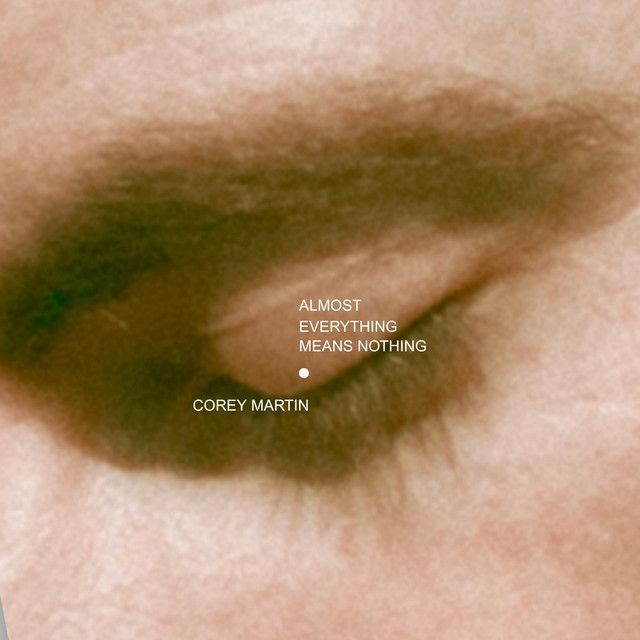
Corey Martin is carving out a space entirely his own, blending orchestral composition with modern production and emotional intuition. His work moves through themes of presence, sincerity, and meaning, creating a sound that feels both cinematic and deeply personal. With his EP Almost Everything Means Nothing now out, Martin steps into a new chapter defined by vulnerability, intention, and a quiet rebellion against cynicism. We caught up with Corey Martin to explore the creative journey, inspirations, and experiences shaping this release.
While currently based in Los Angeles, Martin finds inspiration in the city’s cultural depth, especially through its diversity:
Los Angeles has an incredible food scene. Because of its multicultural makeup of neighborhoods, you really can find some of the best tacos, hummus, pasta, kormas, pupusas, kimchi, and more in the world.
That sense of cultural depth mirrors the way Martin approaches his music, pulling from a wide range of influences and experiences rather than staying confined to a single sound or structure. His work reflects a fluidity that draws from different genres, environments, and emotional states, allowing each piece to exist on its own terms. Rather than adhering to a fixed identity, he embraces that openness, letting his sound evolve naturally as it responds to both his surroundings and his internal creative process.
Living in the Moment
That sense of variety and immersion mirrors how Martin approaches both life and music, reflecting a constant pull between observation and experience. Rather than separating the two, he allows them to inform one another, shaping a creative process that is both reflective and instinctive. Film becomes a natural point of connection within that balance, offering a way to explore emotion, narrative, and perspective in a form that closely parallels how he understands and composes music.
I really love the 2013 film About Time. Domhnall Gleeson plays Tim Lake, a person who has the supernatural ability to time travel to amend certain moments of his life. I’m someone who has struggled to live in the present, often planning for the future or in some dream-like fugue state of writing music in my head. There is a real cry for presence in your own life that works throughout the film which I’ve always connected to.
In my best moments, I’m the Tim Lake at the end, who has decided he actually doesn’t need to go back in time, but instead opts to choose to experience life fully in the moment it’s happening, as if its the second time, for all the good and the bad that it offers. It offers a certain levity to the human experience. Also I cry a lot watching movies and that one and Paddington are sure things.
Finding His Sound
That desire for presence has been shaped by a lifelong relationship with music, one that began early and evolved steadily over time. Raised in a family of musicians, Martin’s initial exposure quickly developed into something more intentional, moving from small, formative moments into a deeper commitment to the craft. What started as curiosity and influence gradually became a defining part of his identity, laying the foundation for a creative path that would continue to expand in both scope and direction.
Music came to me at a very early age as I was raised in a family of musicians. Thankfully we ended up with a VHS promo for the band Hanson and that kinda started the early obsession. From there it turned into starting punk and hardcore bands in the Bay Area alongside my older brother Eric. Eventually, I ended up in music school in Southern California where I fell in love with the orchestra.
From there, his career expanded into film composition, working on projects ranging from Star Wars trailers to campaigns for brands like Apple and Banana Republic. But even with those accomplishments, something began to shift.
I was able to work on a lot of cool things as a film composer early in my career, writing for Star Wars trailers, ads for brands like Apple and Banana Republic, documentaries, and a handful of films very close to my heart. In the process, I slowly found my own voice, blending traditional orchestral with vocalizations, synthesizers, and my own unique sense of production.
That evolution was shaped by both early influences and a growing appreciation for a wide range of artists across genres, each contributing to the way he understands sound and composition today. Rather than drawing from a single source, his influences span across styles and eras, allowing him to approach music with a broader, more flexible perspective. This openness not only informs the way he listens, but also how he builds and layers his own work.
As a kid, I loved bands like Blink-182, Green Day, and Rancid. Matt Freeman of Rancid was a bass player I really looked up to and remember bringing those songs into my bass lessons to learn with my teacher. Nowadays I have a very wide palette of music I love to listen to. Some of my favorites and biggest inspirations include Sufjan Stevens, Porter Robinson, Max Richter, Ethel Cain, Little Simz, Robyn, and Charli XCX.
As his career developed, Martin began shifting away from imitation and toward something more personal, focusing on discovering his own voice rather than replicating others. What once started as an effort to learn through influence gradually evolved into a more introspective process, where identity became just as important as technique. This shift marked a turning point in how he approached composition, moving from external reference points to a more internal, instinct-driven perspective.
Early on, especially as a working film composer I was obsessed with trying to sound like my heroes in the field like John Williams, Hans Zimmer, and Alexandre Desplat. Of course, when you’re trying to sound like visionary once in a generation composers who all have their unique sonic landscape, you’ll probably come up short.
Because of this, I began focusing on creating my own sound as an artist, asking myself the question “what’s the music only I can make?” Using emotional resonance as my guide rather than outward perception of what something should sound like. Hopefully, the end result is the music sounding uniquely like me. I like to think so.
It’s something that shows up clearly in his work, influencing both how he creates and how he experiences the world around him. His music moves between stillness and motion in a way that feels natural, not forced. That same balance carries into his everyday life, where introspection and presence exist at the same time.
Almost Everything Means Nothing
That mindset is realized in Almost Everything Means Nothing, a project rooted in sincerity. Instead of irony, Martin approached the EP as a response to the growing cynicism around him.
Want a closer look at Corey Martin’s work? Watch his videos here.
With this project, I really tried to focus on honesty and sincerity, as much as instrumental music can allow. I have an embarrassingly overwhelming love for music, and I wanted to create something that I really felt deep in my bones, trusting that a handful of people might come along with me. Right now, cynicism is understandably prevalent, and this project for me was my own punk rock rebellion against my own cynicism. A call to find and fight for meaning, purpose, passion, love, friendship, and vulnerability in the face of chaos.
This is where his approach begins to change, reshaping how and why he creates. Rather than making music with an audience in mind, he turns inward, letting instinct and emotional honesty lead. The result is a more intuitive process, grounded in what feels right instead of outside expectation.
“While my project is instrumental, I did very much get a kick out of naming a track after one of my favorite pasta sauces.”
What Comes Next
What began as a personal release has reached a wider audience than Martin expected, reshaping not only how the project is received but how he approaches his work moving forward. The response has reinforced a sense of trust in his instincts, encouraging him to lean further into sincerity and creative freedom rather than second-guessing his choices. It marks a shift from creating in isolation to creating with the understanding that his work is resonating far beyond his original intentions.
To be honest, the reception of this project has been entirely unexpected. I genuinely thought I was just making this for myself and my friends and family. Instead, it’s been met with wide open hearts from so many people. I think that brings a level of encouragement for me moving forward to lean into the things that bring me joy, and to not shy away from sincerity in my writing.
Letting go of the fear of being perceived and instead writing what’s inside of me with less fear of judgement by a nebulous group of critics that might only exist in my head. I mean, there’s like a lot of flutes and other orchestral instruments on this project, so thats cool that people like it.
It marks a turning point in his process, where instinct matters more than expectation. Instead of second-guessing his choices, Martin leans into them and lets the arrangement speak for itself. There’s a growing trust in both his audience and his own voice, where sincerity becomes something he fully commits to.
At the moment it’s just shows around California, but always happy to see that grow if there’s a demand for it. I’m always composing and producing, so the next project is pretty much always in the works. At the moment I have some scoring work I’m very excited to share in the near future. Also working on some artist projects that have me pinching myself.
At the core of everything, Martin emphasizes the importance of maintaining human connection through art, especially at a time when that connection can feel increasingly distant. His work pushes against detachment, instead prioritizing presence, intention, and the emotional weight that comes from something made by hand. It’s a perspective that not only shapes the way he creates, but also how he hopes listeners engage with the music itself:
Support music made by humans. I was incredibly fortunate to be able to hire and work with an orchestra on this project, and it made all the difference in the world. People want to connect with other people through the arts and we should do everything we can to maintain that. Never underestimate human intuition.
Corey Martin’s Almost Everything Means Nothing is out now. Take time to experience the project in full and sit with the emotion and intention behind each piece. As his work continues to evolve, this release marks a defining step in a process rooted in sincerity, creative freedom, and a deeper connection between artist and listener. To explore more of his work and stay up to date on what’s next, visit his website here.


Leave a comment